
Life changes
Preparing Your Child for a New Sibling: Stories, Questions, and Small Routines
A new baby can bring excitement, worry, curiosity, and big questions. Explore practical ways to prepare children ages 3–10 with honest language, optional involvement, protected one-on-one time, and gentle story conversations.
A new sibling is a big change—and mixed feelings are normal
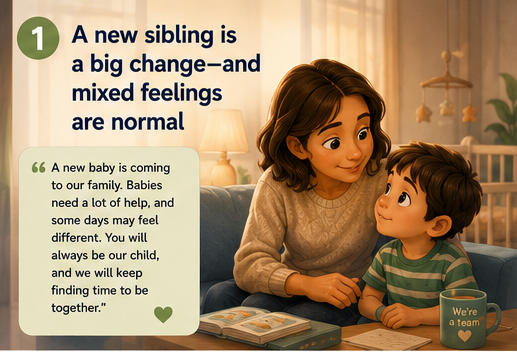
A new baby can be exciting, confusing, and disruptive at the same time. Many children cannot fully picture the change until the baby is home, needs frequent care, and affects familiar routines.
Your child may be delighted one day and worried, annoyed, or uninterested the next. Questions such as "Where will the baby sleep?" and "Will you still cuddle me?" both deserve calm, straightforward answers.
The goal is not to make your child feel happy all the time. Instead, offer clear information, make room for mixed feelings, and protect a few dependable parts of family life.
A simple message might be:
"A new baby is coming to our family. Babies need a lot of help, and some days may feel different. You will always be our child, and we will keep finding time to be together."
Young children may ask the same questions repeatedly. Answering calmly and concretely can give them time to understand the change gradually.
Share information in small, honest pieces
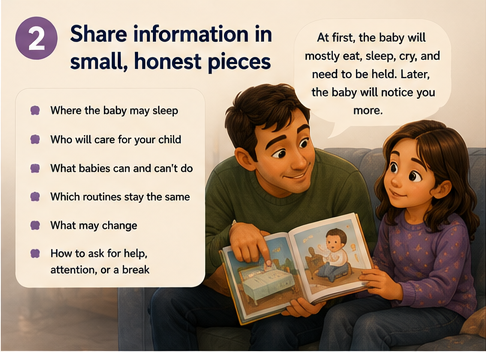
Several short conversations can be easier for children than one long "big talk." Explain what matters now, then return to the topic as the baby's arrival gets closer.
Useful topics include:
- Where the baby may sleep
- Who will care for your child during the birth or hospital stay
- What babies can and cannot do
- Which routines are likely to stay the same
- What may change during the first weeks
- How your child can ask for help, attention, or a break
Avoid promising that the baby will arrive ready to play. You might say, "At first, the baby will mostly eat, sleep, cry, and need to be held. Later, the baby will notice you more and may enjoy watching what you do."
Be honest without adding more detail than your child needs. If you do not know an answer yet, try: "I'm still finding that out. I'll tell you when I know more."
Invite involvement, but make it optional
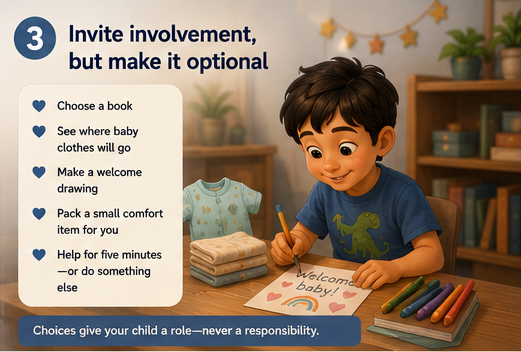
Some children enjoy helping with preparations. Others prefer to watch from a distance. Both reactions are reasonable.
Offer choices rather than responsibilities:
- "Would you like to choose a book for the baby or choose a book for us to read together?"
- "Do you want to see where the baby's clothes will go?"
- "Would you like to make a welcome drawing?"
- "Should we pack one small comfort item for you to bring when you meet the baby?"
- "Would you rather help for five minutes or do something else while I get this ready?"
Optional involvement gives your child a role without making them responsible for the transition. They can be a sibling without becoming a caregiver. If they decline, accept the answer without trying to persuade them.
Protect small moments of one-on-one time
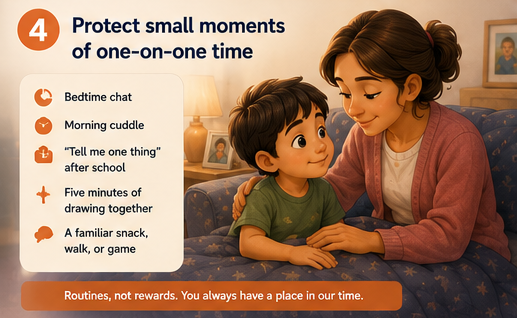
A new baby may make long stretches of uninterrupted parent-child time harder to predict. Connection does not need to be elaborate to be meaningful.
Choose a few realistic rituals, such as:
- A brief bedtime chat
- A morning cuddle or check-in
- A "tell me one thing" conversation after school
- Five minutes of drawing together
- A familiar weekend snack, walk, or game
Describe these as family routines, not rewards for cheerful behavior. Your child should not have to earn attention by seeming pleased about the baby.
When plans change, name a specific next step: "I need to feed the baby now. After dinner, I will sit with you while you choose tomorrow's clothes." If another adult is available, they can also help keep familiar rituals going.
Use stories to open a low-pressure conversation
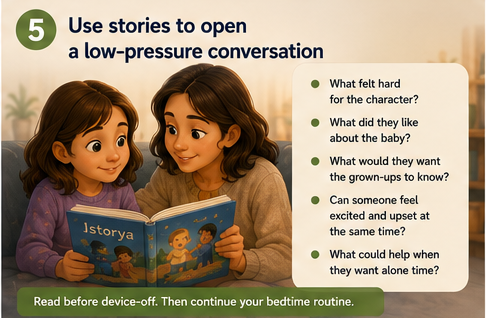
Stories can give children a little distance from a personal subject. A character can feel curious, jealous, proud, worried, or left out without requiring your child to immediately explain their own feelings.
Istorya is in beta and creates illustrated personalized stories with the child as the hero. A story about everyday family changes or values—such as waiting, kindness, sharing attention, or asking for help—can be a gentle conversation starter.
If you choose to read a digital Istorya story as part of bedtime, use it before your household's device-off point. Follow it with the rest of your usual non-device bedtime routine, such as a chat, cuddle, printed book, or quiet song.
After a story, try asking:
- "What do you think felt hard for the character?"
- "What did the character like about the baby?"
- "What would they want the grown-ups to know?"
- "Can someone feel excited and upset at the same time?"
- "What could help when they want alone time?"
If your child changes the subject, let the conversation rest. They may return to it later, perhaps during play, a car ride, or another bedtime.
In the first weeks, narrate what is happening
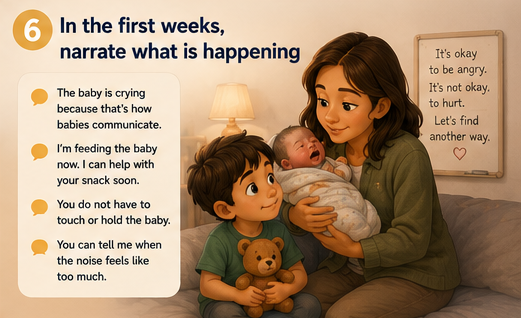
Once the baby arrives, brief explanations can make a busy day feel more predictable:
- "The baby is crying because that is how babies communicate."
- "I'm feeding the baby now. I can help with your snack when I finish."
- "You wanted me right away, and waiting felt hard."
- "You do not have to touch or hold the baby."
- "You can tell me when the noise feels like too much."
A child may seek extra closeness, test limits, or want help with routines they usually manage alone. Respond steadily where possible while keeping clear boundaries: "It is okay to be angry. It is not okay to throw a toy near the baby. Let's find another way to show how mad you are."
Age adaptations: ages 3-5
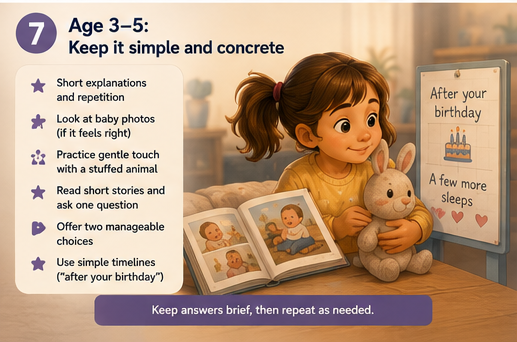
Preschoolers often benefit from simple language, repetition, and visible routines.
Try:
- Using short explanations: "The baby drinks milk and needs lots of sleep."
- Looking at baby photos of your child, if that feels right for your family.
- Practicing gentle touch with a stuffed animal.
- Reading a short illustrated story and asking one question at a time.
- Offering two manageable choices during busy moments.
- Pointing to a simple calendar or using familiar markers, such as "after your birthday" or "after a few more sleeps."
Long timelines can be difficult at this age. Keep answers brief, then repeat them as needed.
Age adaptations: ages 6-10
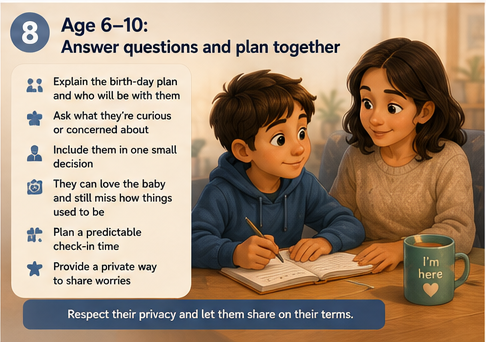
School-age children may notice changes in schedules, attention, and adult energy. They may also have more detailed questions about the birth, hospital plans, visitors, or what life at home may look like.
Try:
- Explaining the birth-day plan and who will be with them.
- Asking what they are curious or concerned about.
- Including them in one small decision, such as choosing a baby book.
- Naming that they can love the baby and still miss how things used to be.
- Planning a predictable check-in after school or before bed.
- Giving them a private way to share worries, such as a note, drawing, or quiet conversation.
Older children may value privacy, too. Let them decide whether and when they want to share the news with friends or classmates.
Keep the message steady, not perfect
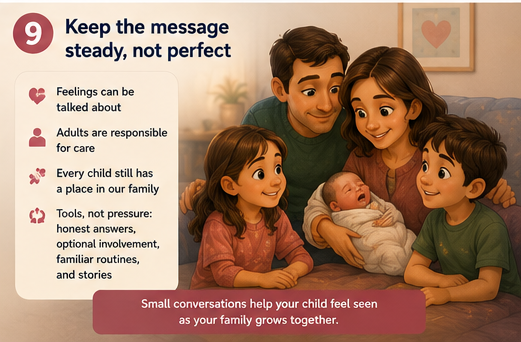
No script can remove every hard moment of becoming a bigger family. What matters is returning to a few steady messages: feelings can be talked about, adults remain responsible for care, and every child still has a place in the family.
Use honest answers, optional involvement, familiar routines, and stories as tools—not pressure. Small conversations can help your child feel seen while your family adjusts together.
Sources and further reading
- American Academy of Pediatrics, "Bedtime Trouble" — https://www.healthychildren.org/English/healthy-living/sleep/Pages/bedtime-trouble.aspx
- American Academy of Pediatrics, "Healthy Sleep Habits: How Many Hours Does Your Child Need?" — https://www.healthychildren.org/English/healthy-living/sleep/Pages/healthy-sleep-habits-how-many-hours-does-your-child-need.aspx
- Child Mind Institute, "Preparing Your Child for a New Sibling" — https://childmind.org/article/preparing-child-new-sibling/
- American Academy of Pediatrics, "Books to Teach Kids About Feelings and Resilience" — https://www.healthychildren.org/English/healthy-living/emotional-wellness/Building-Resilience/Pages/recommended-reading-books-to-teach-kids-about-feelings-and-resilience.aspx