
Life changes
How to Help Your Child Feel More Confident About Starting School
Starting school can bring excitement, questions, and uncertainty. These practical, low-pressure ideas can help parents make the transition feel more familiar.
Starting school can bring big feelings
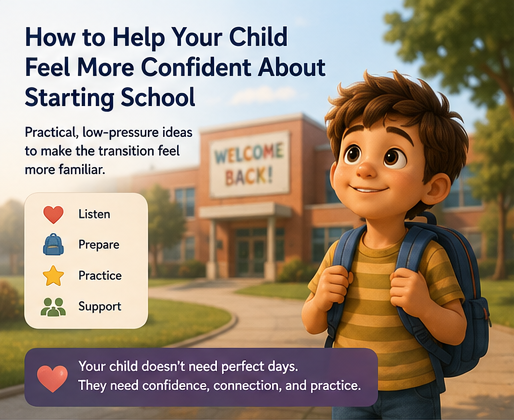
Beginning preschool, kindergarten, or a new elementary-school year can mean many changes at once: a classroom, adults, routines, early mornings, and drop-off may all be new.
Some children say they feel excited, worried, or both. Others show uncertainty through extra questions, clinginess, irritability, changes in play, or a stronger preference for familiar routines. These reactions do not automatically mean something is wrong. Calm listening and practical preparation can make school feel less unknown.
The goal is not to remove every worry or promise that the first days will be easy. It is to help your child understand a little more about what to expect, practice a few everyday skills, and know they can bring questions to you and other trusted adults.
Listen before trying to solve the problem
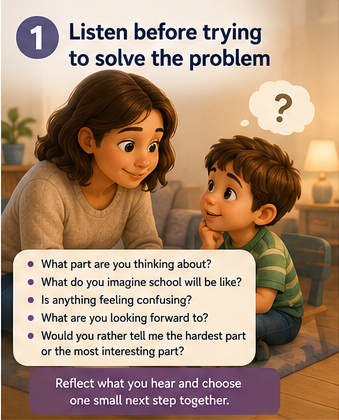
When a child says, "I don't want to go to school," it can be tempting to respond quickly with, "You'll love it!" Reassurance can be helpful, but starting with curiosity gives your child room to explain what they mean.
Try questions such as:
- "What part are you thinking about?"
- "What do you imagine school will be like?"
- "Is anything feeling confusing?"
- "What are you looking forward to?"
- "Would you rather tell me the hardest part or the most interesting part?"
Reflect what you hear: "It sounds like you're wondering who you will sit with at lunch," or, "You're excited about art, but saying goodbye feels hard."
You do not need a perfect answer. Sometimes children mainly need to know their feelings make sense. Then choose one small next step together, such as looking at the school website, practicing with a lunch container, or talking through drop-off.
Make the school day more familiar
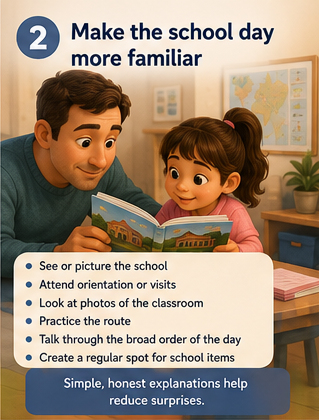
Familiarity can reduce surprises. If possible, help your child see or picture the school before the first day.
A few practical preparations can help:
- Walk or drive by the school and point out the entrance.
- Attend orientation, a classroom visit, or a meet-the-teacher event.
- Look at photos of the classroom, playground, bus area, or staff.
- Practice the route to school around the usual morning time.
- Talk through the broad order of the day: arrival, class, snack or lunch, recess, pickup, and home.
- Choose one regular place at home for the backpack, coat, water bottle, and shoes.
Keep explanations simple and honest. You might say, "I don't know exactly where you will sit yet, but your teacher can help you find your place." This shows that it is okay not to know every detail in advance.
For younger children, make a simple picture sequence: wake up, get dressed, breakfast, travel to school, say goodbye, learn and play, then come home. It does not need to be a rigid schedule; it simply gives the day a recognizable shape.
Practice small routines and self-help skills
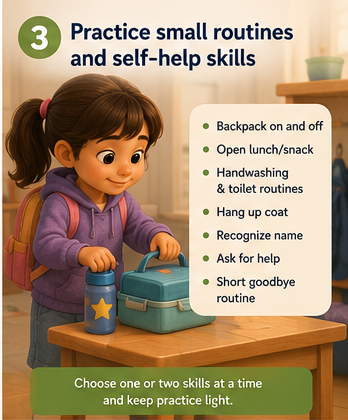
Children do not need to master every school skill before they start. Practicing a few everyday tasks may make certain moments feel more manageable.
Choose one or two skills at a time:
- Putting on and taking off a backpack
- Opening a lunchbox, snack wrapper, or water bottle
- Managing handwashing and toilet routines
- Hanging up a coat
- Recognizing their name on a label
- Asking an adult for help
- Using a short goodbye routine
Keep practice light. A few minutes before an outing is often enough. If a task becomes frustrating, step in calmly and break it into smaller parts.
Instead of saying, "You need to do this by yourself," try, "Let's find the tricky part. You hold the container while I show you the tab." Your child can try again later.
Preparing school items together can also invite participation. Let your child choose between two suitable outfits, help pack the backpack, or decide where school items belong at home. Small choices offer involvement without placing too much responsibility on them.
Use role-play for unfamiliar moments
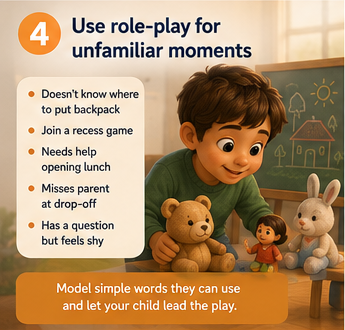
Pretend play gives children a low-pressure way to explore school situations. Use stuffed animals, dolls, action figures, or household objects to act out a short school day.
One toy can be the child, another the teacher, and another a classmate. Try scenes where a character:
- Does not know where to put their backpack
- Wants to join a recess game
- Needs help opening lunch
- Misses their parent at drop-off
- Has a question but feels shy about raising a hand
Model simple words your child could use:
- "Can you help me?"
- "Where does this go?"
- "Can I play, too?"
- "I need the bathroom."
- "I feel worried."
- "When will my grown-up come back?"
Let your child change the story. They may repeat a goodbye scene, make the teacher especially kind, or have a character hide. Follow their lead rather than correcting the play. Their choices can show what feels most important to them.
Use an optional Istorya story for conversation
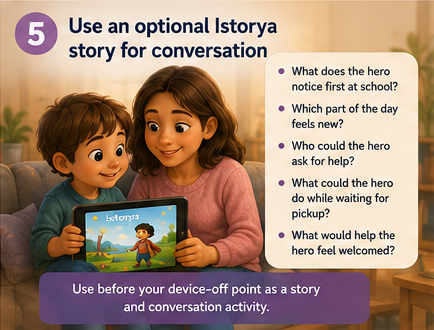
Istorya is in beta and creates illustrated personalized stories with the child as the hero. A story can explore an everyday school moment or a value such as kindness, curiosity, patience, or asking for help.
For example, your child's character might find the cubbies, meet someone at recess, or ask an adult for help at lunch. Keep the plot grounded in ordinary situations. A brave character does not need to be fearless; they might ask a question, try again, or notice something new.
A digital Istorya story belongs before your household's device-off point in the bedtime routine. Use it as a brief story-and-conversation activity alongside real-world preparation and communication with your child and their school.
Try prompts such as:
- "What does the hero notice first at school?"
- "Which part of the day feels new?"
- "Who could the hero ask for help?"
- "What could the hero do while waiting for pickup?"
- "What would help the hero feel welcomed?"
Adapt your approach by age
Ages 3-4: Keep it concrete and brief
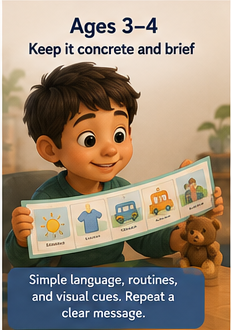
Use simple language, repeated routines, and visual cues. Focus on things your child can see and do: backpack, teacher, snack, playground, goodbye, and pickup.
Short role-play can work well. Repeat a clear message: "You will go to school, your teacher will be there, and I will come back after school."
Ages 5-7: Practice everyday school moments
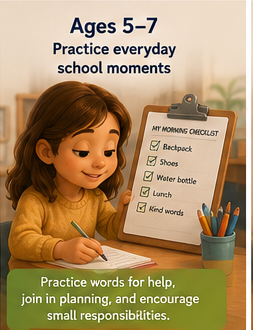
Children in early elementary school may wonder about friends, rules, lunch, bathrooms, or making mistakes. Invite questions and practice words for asking for help or joining play.
They may enjoy helping create a short morning checklist or choosing a small familiar item for their backpack.
Ages 8-10: Make room for social and practical concerns
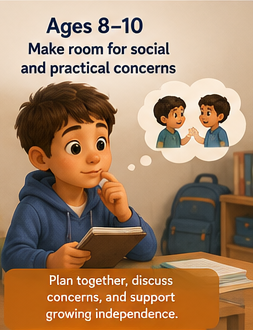
Older children may be more aware of peer groups, academic expectations, schedules, and growing independence. Avoid assuming they are too old to feel uncertain.
Ask what they have heard from friends or older siblings. Plan together for practical situations, such as organizing materials, finding a classroom, or deciding whom to ask for help.
Keep the first weeks steady

Once school begins, predictable mornings and brief goodbyes can make the routine clearer. Choose a simple ritual: a hug, wave, phrase, or reminder of the pickup plan. Keep it warm and consistent.
After school, allow time to decompress. Some children want to talk immediately; others need a snack, movement, quiet play, or downtime first. Try specific invitations:
- "What is one part you remember?"
- "What felt easy today?"
- "What felt new?"
- "Who did you spend time with?"
- "Was there a time you needed help?"
If concerns continue and regularly disrupt sleep, eating, attendance, or family routines, consider speaking with your child's teacher, school counselor, pediatric professional, or another qualified child-development professional.
Sources and further reading
- American Academy of Pediatrics, "Bedtime Trouble"
- American Academy of Pediatrics, "Healthy Sleep Habits: How Many Hours Does Your Child Need?"
- Child Mind Institute, "Starting Elementary School"
- Cleveland Clinic, "How to Prepare Kids for School"
- PBS Parents, "Managing Back-to-School Feelings"