
Personalized stories
Personalized Bedtime Stories for Kids: How to Choose a Calm Story Ritual
Personalized stories can give families a gentle way to wind down, talk about everyday moments, and make reading feel more familiar. Here is how to choose a story and build a calm, bounded bedtime ritual that fits your child's age.
A personalized story can be one part of bedtime
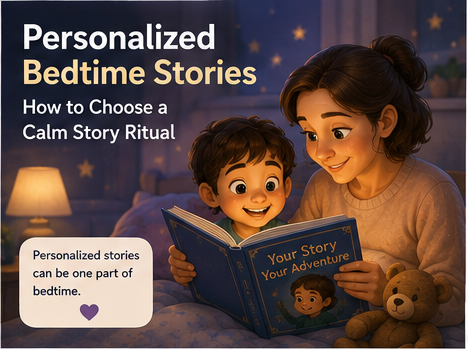
Bedtime often includes practical steps: changing clothes, brushing teeth, putting away toys, choosing a book, and saying goodnight. A story does not need to solve every bedtime challenge to have a place in the routine. It can simply be a predictable, pleasant transition toward rest.
Istorya is in beta and creates illustrated personalized stories with the child as the hero. Its stories focus on values and everyday situations, such as sharing, getting ready for school, welcoming a new sibling, trying an activity, or handling a disagreement with a friend. They are illustrated and text-based; Istorya does not use photo uploads, audio, voice, or voice cloning.
For some families, seeing themselves as the hero in a fictional story may offer an easy opening to discuss a feeling or part of the day. For others, it may simply be a cozy reading choice. Both are valid.
Keep the ritual calm, brief, and flexible rather than making it another task that has to "work."
Questions to ask when choosing a bedtime story
Is the tone right for the end of the day?
A bedtime story can include a small problem, but a gentle pace and settled ending may fit the time of day better. Consider familiar routines, low-stakes adventures, kindness, or preparing for a change.
If mysteries, chase scenes, or cliffhangers leave your child energized, save them for daytime reading when possible.
Does it match your child's interests?
A child who loves gardens, animals, space, buses, baking, or forts may be more interested in a story that includes those elements. Personalization does not need to recreate real life exactly. A little imaginative distance can keep a topic playful.
For example, a child facing a classroom change might enjoy helping a lost library book find its shelf. The story can explore curiosity or asking for help without retelling a difficult day.
Is the theme simple enough to discuss?
Choose one main idea. A story about taking turns can lead to a short conversation about sharing; packing a bag can connect to school mornings; welcoming a baby can leave room for questions about family changes.
Does it fit the evening you have?
A ritual should work on tired, busy nights, too. Read one short section, look at a few illustrations, or return to the same story over several evenings. Finishing every story is not required.
A five-step calm, bounded story ritual
1. Complete bedtime basics first
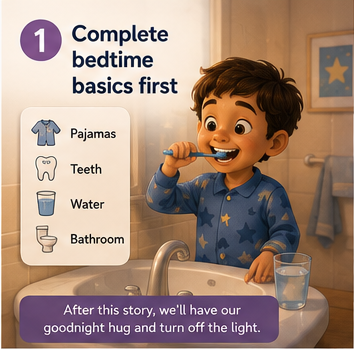
Before reading, handle pajamas, toothbrushing, water, and bathroom visits. You might say, "After this story, we'll have our goodnight hug and turn off the light." This helps keep reading from becoming a bargaining point.
2. Offer one small choice
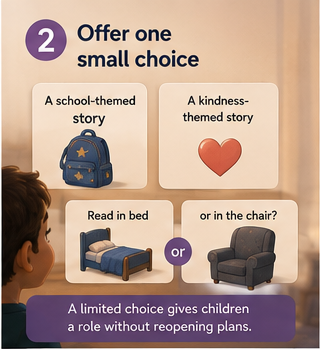
Give two options that both work for your routine: "A school-themed story or a kindness-themed story?" "Read in bed or in the chair?" A limited choice gives children a role without reopening bedtime plans.
3. Read at an unhurried pace
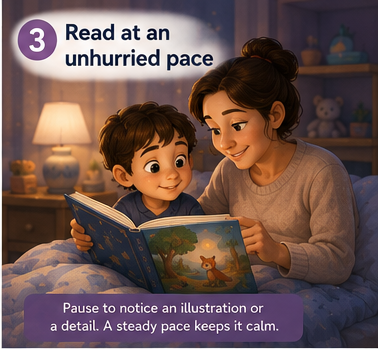
Pause to notice an illustration, familiar detail, or funny moment. A steady pace can help the story remain quieter than the rest of the evening. If your child lingers on a page, acknowledge it briefly and continue.
4. Ask one low-pressure question
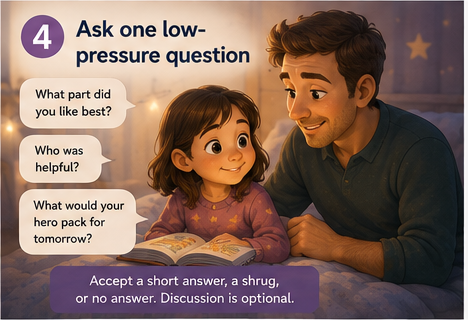
Try, "What part did you like best?" "Who was helpful?" or "What would your hero pack for tomorrow?" Accept a short answer, a shrug, or no answer. Discussion is optional.
5. End the same way each night
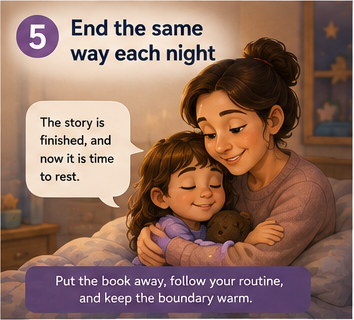
Use a predictable closing phrase: "The story is finished, and now it is time to rest." Put the book away, follow your usual goodnight routine, and keep the boundary warm: "We can choose another story tomorrow."
Age adaptations for ages 3-10
Ages 3-4: Keep it concrete and short
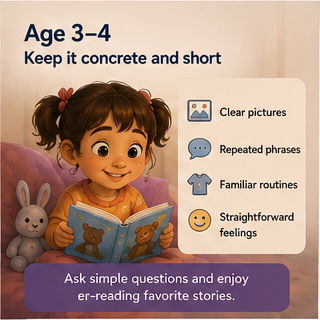
Choose clear pictures, repeated phrases, familiar routines, and straightforward feelings. Stories about getting dressed, helping at home, visiting a park, playing with a sibling, or going somewhere new may be easy to follow.
Ask simple questions: "Is the hero happy, sad, or worried?" or "What animal do you see?" Children this age may enjoy rereading the same story many times.
Ages 5-7: Explore everyday problem-solving
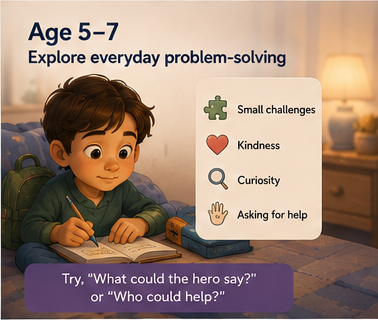
Children in this range may enjoy a small challenge: forgetting a lunchbox, joining a game, caring for a pet, meeting a teacher, or trying something new.
Try questions such as, "What could the hero say?" or "Who could help?" Keep the connection to everyday life light and let children decide how much they want to share.
Ages 8-10: Add perspective and independence
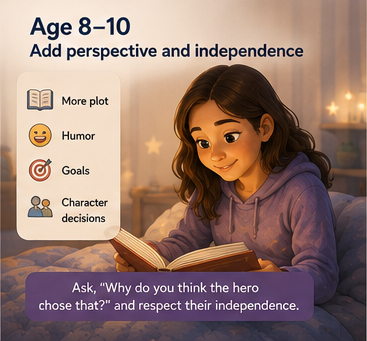
Older children may prefer more plot, humor, goals, and character decisions. Friendship, teamwork, responsibility, family changes, and school preparation can offer useful themes.
Ask, "Why do you think the hero chose that?" or "Would you have done something differently?" If your child is tired or uninterested, let the story remain a story.
Put digital reading before the device-off point
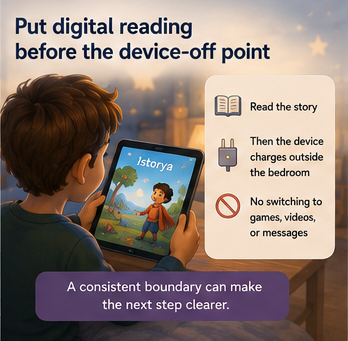
A digital Istorya story belongs before your household's device-off point. It is not a screen-free activity. If you use a phone, tablet, or computer to access a story, decide in advance when reading ends and where the device goes next.
Keep the device focused on the story rather than switching among games, videos, messages, or notifications. A simple boundary might be: "We'll read this story, then the device charges outside the bedroom." If a printed reading option better suits your household, use that instead.
A consistent boundary can make the next step clearer for some families.
Let the ritual stay flexible
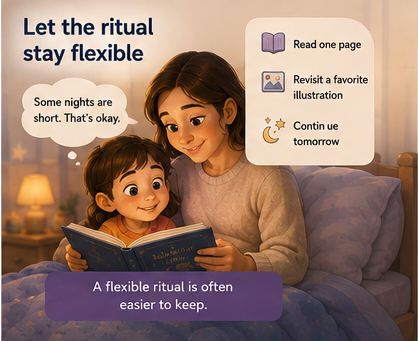
Some evenings will not allow time for a full story. Read one page, revisit a favorite illustration, or say, "Tomorrow we'll see what happens next." A flexible ritual is often easier to keep than an elaborate one.
Istorya can be an optional addition to a family reading routine: an illustrated personalized story, a brief moment of connection, or a gentle conversation prompt. Keep what fits and let bedtime remain practical, calm, and your own.
Sources and further reading
- American Academy of Pediatrics, "Bedtime Trouble"
https://www.healthychildren.org/English/healthy-living/sleep/Pages/bedtime-trouble.aspx
- American Academy of Pediatrics, "Healthy Sleep Habits"
- Child Mind Institute, "Starting Elementary School"
https://childmind.org/article/starting-elementary-school/
- Cleveland Clinic, "How to Prepare Kids for School"
https://health.clevelandclinic.org/how-to-prepare-kids-for-school
- Child Mind Institute, "Preparing Your Child for a New Sibling"
https://childmind.org/article/preparing-child-new-sibling/
- American Academy of Pediatrics, "Books to Teach Kids About Feelings and Resilience"
- PBS Parents, "Managing Back-to-School Feelings"
https://www.pbs.org/parents/thrive/managing-back-to-school-feelings-with-arthur